Norwegian census records: how to find your ancestor’s family
Which Norwegian census to search, how to use Digitalarkivet in English, how to read an entry, and how to tell if the family is really yours.
By Heimkin · Updated October 23, 202620 min read

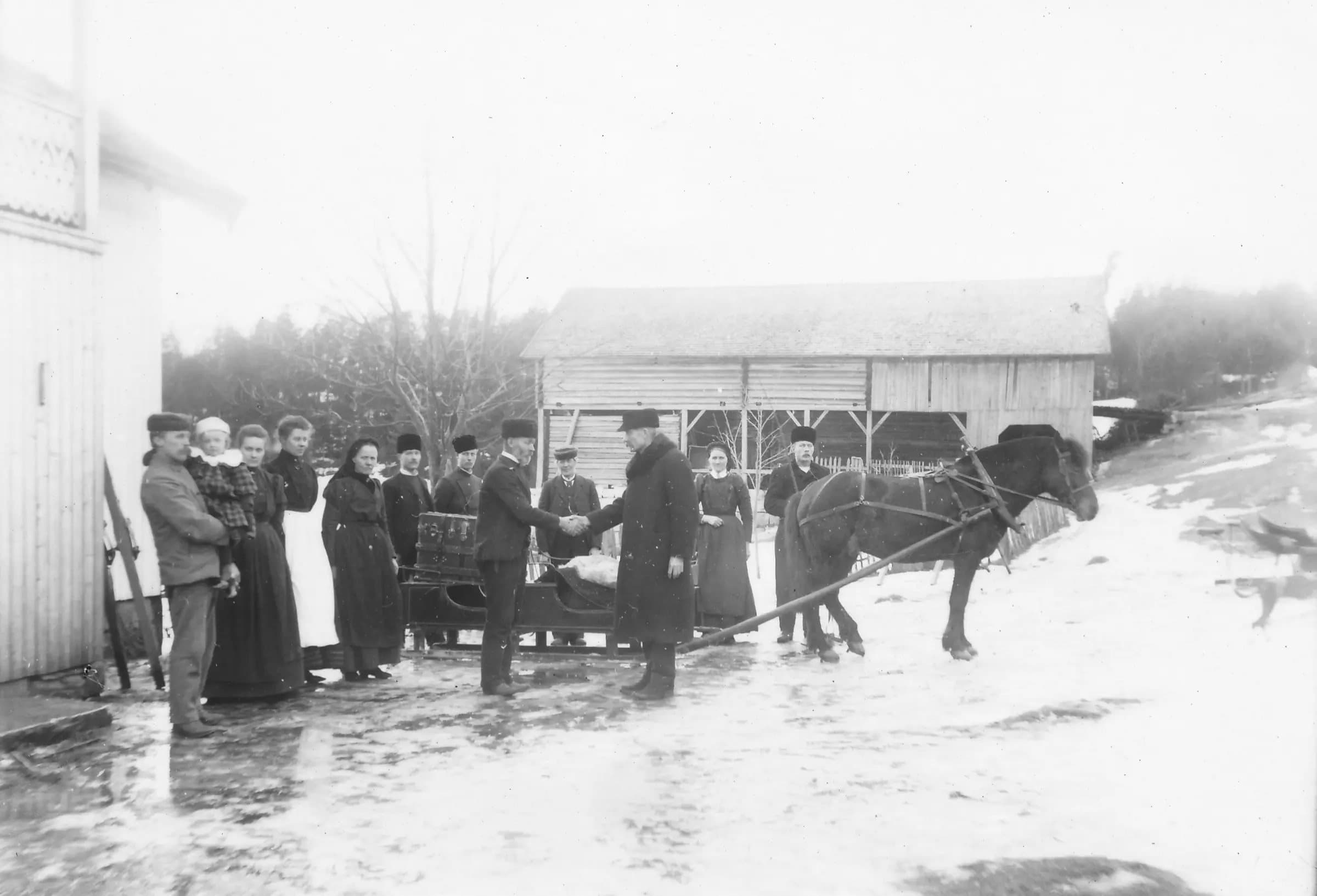
About this photo
Emigrants and the people seeing them off at the quay in Kristiania, now Oslo, as the Wilson Line’s Montebello leaves in May 1903. Photo: Anders Beer Wilse, Norsk Folkemuseum, via the National Library of Norway. Public domain.
In this article
Search a Norwegian archive for the name on an American record and you may get no results at all. Often that’s because the name your ancestor used in America isn’t the one the family used in Norway. This guide takes you from that American record to the family in the Norwegian censuses, on Digitalarkivet, the website of the National Archives of Norway.
Search the Norwegian censuses on Digitalarkivet (opens in a new tab)digitalarkivet.no
The censuses are free to search, the menus are in English, and you don’t need to log in. Two things decide how it goes: the census taken just before your ancestor left, and the name they went by in Norway. The name is the hard part. The man in our example below turns up under three different names. If your American record only says “Norway,” skip ahead to the emigrant lists. The section “The American record only says Norway” near the end shows how.
Which census to search
Pick the census first. Searching the wrong one is an easy way to decide your family isn’t there. A census lists almost everyone living in Norway on one day, and these are the ones that name every person:
| Census | Census day | What it gives you to search on |
|---|---|---|
| 1801 | February 1, 1801 | Name and age, no birthplace |
| 1865 | December 31, 1865 | Age and birthplace |
| 1875 | December 31, 1875 | Birth year and birthplace |
| 1891 | New Year 1891 | Birth year and birthplace |
| 1900 | December 3, 1900 | Birth year and birthplace (a full date only for babies born in 1900) |
| 1910 | December 1, 1910 | Full date of birth for everyone, and birthplace |
| 1920 | December 1, 1920 | Full date of birth and birthplace; only about half the fields are searchable |
The 1870 and 1885 censuses covered only the towns, so skip them unless your family lived in one. Any census can have gaps, and Digitalarkivet marks some years as incomplete, 1891 among them. Don’t take a miss at face value. Before you decide your family isn’t in a census, search on the farm or parish alone and check that the place is in it.
Look first in the last census taken before your ancestor left, then in the one before that if they were already born. Our example man, Ole N. Berg, left in 1883. His last census in Norway is 1875, when he was 12. In 1865 he’s a small boy living with both parents. So those are the two we search.
Check the census day too, if your ancestor left close to one. Someone who left in March 1900 was gone before December 3, so 1891 is their last census. Someone who left in January 1901 is in the 1900 census. The censuses taken after your ancestor left are worth a look as well, because they show the family that stayed.
Before 1865 it gets harder. If your ancestor left before the end of 1865, the censuses that name everyone won’t list them, unless they were born by 1801. Some of the counts between 1815 and 1855 have name lists for parts of the country, and the censuses from 1865 on can show the brothers and sisters who stayed. The last section has more on leaving before 1867.
Searching Digitalarkivet in English
Once you’ve picked the census, the search itself is short. Start on Digitalarkivet’s English home page (opens in a new tab), choose “Censuses,” then a year. Each year has one search page for the whole country, such as the 1865 census search (opens in a new tab).
- Type only the first name, the way your ancestor used it in Norway. It feels wrong to leave the last name empty. Do it anyway, because the American last name often isn’t in the Norwegian records (the example below shows why). Leave “Disable name variants” unchecked, so the search also finds other spellings.
- In “Date of birth,” type just the year. The label says date, but a year is what it wants.
- Residence is the box to use if you know the farm or the parish. Type the start of its name and end it with an asterisk, like
Dokk*. The asterisk stands for the rest of the word. It has to go at the end, because a star at the front doesn’t work in “Residence.” You can also pick the parish under “Geography.” Check only the parish. If you check the county too, the search covers the whole county. Leave “Place of birth” empty, because it only matches the clerk’s spelling of the parish (more on that below). - Click “Search,” then a name. The record shows the whole household under “Residents,” and the “Scanned” button opens the original page, so you can read the handwriting yourself.
The entries themselves aren’t in English. They’re in Norwegian, as the clerk wrote them and a transcriber read them. The only exception is a value the archive worked out itself, which is marked “(calculated).” The example below explains the words you’re most likely to meet. Digitalarkivet also has an English list of the abbreviations (opens in a new tab).
Following Ole N. Berg back to Norway
The rules make more sense on a real search, so here is one from start to finish, with the wrong turns left in.
The clue from Minnesota
We started with a man in a Minnesota county history. Ole N. Berg ran a general store in Zumbrota. The History of Goodhue County, Minnesota (opens in a new tab) (1909) is free on the Internet Archive, and page 785 has a short biography of him:
Ole N. Berg, of Zumbrota village, was born in Norway, Vestre Slidre Valdres, April 12, 1863, son of Nels and Gertrude (Dokken) Berg, also native of Norway. The father died in 1875 and the mother in 1903. Mr. Berg received his education in Norway and emigrated to America in 1883, locating at Decorah, Iowa, where he was engaged in clerking for eight years.
That’s a good start. It gives an exact birth date, a parish, both parents’ first names, the year his father died, the year Ole left and the town he went to. Valdres is a region of Norway. Vestre Slidre, one of its six municipalities, is the parish. Ours is a county history. Yours may come from an obituary, a naturalization paper or a US census line instead.
Finding the household
The obvious first search is the name from the book: Ole Berg, born 1863. In the 1865 census that gets no hits. In 1875 it gets one, an Ole Olsen Berg, born 1863. That looked like our man. It wasn’t: he was born in Ytterøy in Trøndelag. A matching name and birth year can still be the wrong man, so check the place and the parents before you accept a hit like that.
The way forward is in the parentheses. “Gertrude (Dokken)” looks like a maiden name. In a US biography, though, the name in parentheses after a Norwegian mother can be a farm. So we searched for Dokken as the residence:
- Ole, born 1863, residence
Dokk*, in the 1865 census (opens in a new tab): 1 hit - The same search in the 1875 census (opens in a new tab): 1 hit
One hit each time. The asterisk means anything can follow it. The search also matches any single word inside a longer place name. That’s why Dokk* still finds the farm in 1875, when the clerk wrote it as Smelinge Nedre Dokken.
Reading the 1865 entry
The one hit in 1865 is Ole Nielsen, age 3, at Dokken in Vestre Slidre. There he is, with his parents, a sister and two brothers (his record in the 1865 census (opens in a new tab)). This is the household, as the record and the scanned page (opens in a new tab) give it:
| Name | Age | In the record | What it means |
|---|---|---|---|
| Niels Sevaldsen | 46 | Husfader, g, Gaardbruger og Selveier | Head of the household, married, a farmer who owns his land |
| Gjertrud Monsdatter | 38 | hans Kone, g | His wife, married |
| Marit Nielsdatter | 14 | deres Datter, ug | Their daughter, unmarried |
| Eivind Nielsen | 12 | deres Søn, ug | Their son, unmarried |
| Halvor Nielsen | 7 | deres Søn, ug | Their son, unmarried |
| Ole Nielsen | 3 | deres Søn, ug | Their son, unmarried |
The ages don’t line up on the sheet, because men’s and women’s ages have separate columns. Gjertrud’s 38 and Marit’s 14 sit further to the right than the others.
Four last names, and none of them is Berg. That was the usual way to name people then. They’re patronymics, names built from the father’s first name: -sen for a son, -datter for a daughter. Niels is Sevaldsen, son of Sevald, so his children are Nielsen and Nielsdatter. His wife keeps her own father’s name, Monsdatter, daughter of Mons. Ole Nielsen is Ole, son of Niels, the “Nels” of the county history.
The spelling is old. In it, aa is the modern å, so Gaard is gård, a farm, and a Gaardbruger is someone who farms one. Selveier means Niels owns his land instead of leasing it.
One more thing looks wrong and isn’t. Ole is listed as 3, but he was really 2. The clerks usually wrote the age a person would reach at their next birthday. Ole was born in April 1863, so on December 31, 1865, he was two. Digitalarkivet takes off the extra year for you and shows his birth year as 1863 (calculated).
1875: the father has died
Ten years later the household has changed. Ole Nilsen’s 1875 record (opens in a new tab) (scanned page (opens in a new tab)) gives the farm as Smelinge Nedre Dokken and spells the boys’ name Nilsen. Don’t expect the same spelling twice. The form now asks for a birth year instead of an age, and the father is gone:
- Gjertrud Monsdatter, born 1828, “Husmoder (N Sevaldsens Enke)”: the woman of the house, N. Sevaldsen’s widow (Enke). She’s marked e for widowed, and she now owns and runs the farm herself (“Selvejer og Gaardbruger”).
- Eivind Nilsen, born 1854, and Halvor Nilsen, born 1858, “Hendes Søn” (her son), both “Hjælper Moderen,” helping their mother.
- Ole Nilsen, born 1863, “Hendes Søn,” “Hos Moderen”: living with his mother.
- Kari Knutsdatter Røen, born 1862, “Husmoderens Søsterdatter”: her sister’s daughter.
Checking the match: the baptism
Once you have a household that fits, you still need proof it’s the right one. The best proof is the exact birth date. Baptism entries in the church books can give the birth date as well as the baptism date, and Digitalarkivet lets you search on it across the whole country.
So we searched on the birth date alone, with no place at all. In the advanced person search (opens in a new tab), we entered the first name Ole, the birth year 1863 and the birth date 04-12 (month first, then day). That search (opens in a new tab) gives 8 hits, two of them in Vestre Slidre. Both are boys named Ole, born April 12, 1863, and baptized May 31, on neighboring lines of the same page. Same name and same birthday, one line apart. Only their parents differ. One is the son of Ole Knudsen and Ingeborg Larsen. The other (opens in a new tab) is the son of Nils and Gjertrud Monsdatter, which fits the Dokken parents.
The index gives that boy’s father as Nils Sivelvin and the place as Bakken. That doesn’t look like Sevaldsen or Dokken, and the scan shows why. On the scanned page (opens in a new tab), line 54 reads, as far as we can read the handwriting, “Nils Sivaldsen Dokken(?) og Gjertrud Monsd” (og is “and”). Whoever typed up the index misread Sivaldsen, and probably Dokken. A search for the father’s name would have missed this baptism; the birth date found it. When an index entry almost fits, open the scan and read the line yourself.
The father’s burial is in the church book too: Nils Sevaldsen, buried in 1875 (opens in a new tab). The index gives no age and no farm, but the scanned page (opens in a new tab) says he was 55 and lived at Dokken. That fits his age in the 1865 census.
Olaf Dokken in the emigrant list
The last piece is the leaving itself. From 1867, the Norwegian police kept lists of the people who registered to emigrate. They give each person’s age, home parish and destination. Most of the lists that survive, up to about 1930, are on Digitalarkivet. In the advanced person search, they’re the source category “Emigration records,” and the archive’s own titles call them emigrant protocols.
We tried Ole Dokken, born 1863, with 1883 as the event year, and got no hits. With Olaf instead of Ole, there was one (opens in a new tab):
| Field | In the record | What it means |
|---|---|---|
| First name, Surname | Olaf Dokken | Olaf instead of Ole, and the farm as a last name |
| Age | 20 | Born about 1863 |
| Occupation | Arb | Laborer |
| Residence | V. Slidre | Vestre Slidre |
| Departure date | 1883-04-20 | Left on April 20, 1883 |
| Destination | Decorah | Decorah, Iowa |
That’s him: 20 years old, a laborer from Vestre Slidre, leaving for Decorah on April 20, 1883. The record (opens in a new tab) comes from the Oslo police district’s emigrant list for 1882 to 1883 (scanned page (opens in a new tab)). He had company: three other young men from Vestre Slidre were booked with him, all going to Decorah. They were Gullik B. Veste, Ole Engebretsen and Anders T. Ulven. Their ship was the Angelo.
Is it the same man?
He’s Ole Nielsen or Nilsen in the censuses, Olaf Dokken in the emigrant list and Ole N. Berg in Minnesota. We checked each record against the county history, and each one matches it on something different:
- The baptism has the exact birth date and the parents’ first names.
- The 1865 census puts those parents on the Dokken farm.
- The burial, and Gjertrud as a widow in 1875, show that the father died in 1875.
- The emigrant list has the year, the parish and Decorah. The police wrote it at the port, so it doesn’t depend on the county history.
- The county history calls the mother “Gertrude (Dokken).” In 1891 Eivind heads the household at Dokken, and his mother, “Gjertrud Monsdtr Dokken,” lives with him. In 1900 he still farms Dokken, and a widowed Gjertrud Dokken, born 1828, is still in the parish.
Two things stay open. First, no single record names both Olaf Dokken and Ole N. Berg. The emigrant list gives no parents and no birth date. So the link rests on everything else matching: the age, the parish, the farm, the year and the town. That’s a strong case, but it’s still our conclusion, and no record says it outright. Second, nothing in Norway explains Berg. It isn’t in any of these records, and we didn’t follow it up on the American side, so we don’t know where it came from. The county history doesn’t say where its facts came from either, so treat each one as a lead until a Norwegian record backs it up.
When you get stuck
Ole’s search got easier once we had the farm name. Yours may stall earlier. These are the snags to expect, each with what we’d try first.
The American surname isn’t in Norway
Rule this one out first, because it makes a search look hopeless when it isn’t. Ole Berg isn’t the only case. According to the 1917 History of Trempealeau County (opens in a new tab), Lars J. Dahl of Trempealeau County, Wisconsin, was born in Tolgen (today’s Tolga) on April 8, 1850. A search for Lars Dahl, born 1850, finds nothing in the 1865 census. The book itself says why: Lars, “while in Norway, used his father’s surname of Hulbakdahl, shortening it to Dahl after coming to America.” In 1865 he’s Lars Johnsen, son of John Paulsen, on the Hulbækdahl farm. When he left in 1870, the emigrant list has him as Lars Hulbækdal (opens in a new tab), going to Lansing. When the last name fails, search the first name, the birth year and the place instead.
The farm’s name is spelled two ways in his records. It’s Hulbækdahl in the 1865 census and Hulbækdal in the emigrant list, where it’s his surname. His baptism is on Digitalarkivet twice, from two copies of the church book, once with each spelling. Lars, born 1850, residence Hulb* (opens in a new tab) finds him either way (1 hit). Keep the first name and year in the search. Hulb* alone also catches other farms, such as Hulbæk in Skjeberg.
Sometimes the American surname is a patronymic. The 1916 History of Otter Tail County, Minnesota, calls Ludvig Jenson “the son of Jens and Maria Olson.” In the 1865 census (opens in a new tab) he’s Ludvig Jensen, 14, on the Braaten farm in Eidsvold. His parents are Jens Olsen and Marie Larsdatter. So Jenson is Jensen, son of Jens. The book gives both parents the last name Olson, which is the father’s Olsen. In Norway the mother was Larsdatter.
First names changed too. A 1913 history of Allamakee County, Iowa, says of one man: “He was christened Lars, but later Americanized the name into Louis.”
The birthplace box wants the clerk’s spelling
Our advice is to leave the birthplace box empty. We searched the 1875 census for Ole Nilsen or Nielsen (Nil*|Niel*), born 1863, and changed only the birthplace:
The 1875 clerks spelled the parish in several ways, among them Røens S. v. Slidre and Lomes Sogn Væs Slidere (sogn means parish). Slidre* can’t catch the second one, which has an extra e: Slidere. In 1865 plain Vestre Slidre works (4 hits), so a search can work in one census and fail in the next.
A modern name fails too. Lars, born 1850, gets 0 hits in 1865 with Tolga or Tolgen as the birthplace, and 1 hit with Tolg*. The sheet says Tolgens Prgj., short for prestegjeld, a district served by one priest. It can hold more than one parish.
Use “Residence” instead, as in step 3, and read the birthplace off the hits.
Same name, same year, same parish
When the first hit fits, check whether a second one fits too. Ole Nilsen was a common name. Search the 1865 census for Ole Nilsen or Nielsen (Nil*|Niel*), born 1863, and you get 87 hits. Four of them were born in Vestre Slidre. Across the 1865 and 1875 censuses, at least three Vestre Slidre households had an Ole born in 1863 and a father named Nils. Two of the mothers were named Gjertrud.
The closest one is Ole Nilsen at Pladsen Ringen (opens in a new tab) in 1875: born 1863, father Nils Olssen, mother Gjertrud, in Vestre Slidre. On those facts alone he could be our Ole. His mother’s patronymic says otherwise. She’s Gjertrud Pedersdatter, while Ole Berg’s mother was Monsdatter. His father is a Husmand med Jord, a man who rents a small place with some land on someone else’s farm. His brothers and sisters are Berit, Peder, Tollev and Marit. Only the name Marit turns up in both families, and there’s no Eivind or Halvor at Ringen.
Be careful with record links that someone else has made. The “HBR” button on a census record leads to histreg.no. It’s a register that links one person’s records across censuses and church books, partly by computer and partly by volunteers, and it’s in Norwegian only. For the Ole at Dokken in 1865, it links him to the Ringen Ole in 1875, the wrong boy. Treat links like that as hints, and compare the households yourself.
The American record only says “Norway”
If “Norway” is all you have, go to the emigrant lists first. They give the home parish, which is the piece you’re missing. Search “Emigration records” with the first name, the birth year (give or take a year) and the year they left as the event year. Budget for some clicking: the destination isn’t a search field, so you’ll have to open the hits one by one.
For Ole or Olaf, born 1863, leaving in 1883, we got 93 hits, and only one was going to Decorah. (Widen the birth year by one each way, from 1862 to 1864, and the same search gives 245.) For Lars, born 1849 to 1851, leaving in 1870, there were 39 hits. Three were going to Lansing, which was Lars’s own destination. The destination only narrows the list. The birth year and the father’s name settled it: the other two were born in 1851, and their patronymics, Kristensen and Larsen, don’t fit a father named John.
A place in a US record can also be wider or vaguer than it looks. Valdres and Hallingdal are regions, so try their parishes one at a time, along with a date or the parents’ names. “Near Christiania” (today’s Oslo) can mean a rural parish well north of the town. For Ludvig Jenson it meant Eidsvold.
When you need another clue first
Sometimes the best move is to stop searching and find one more clue.
- If you don’t know the year they left, you can’t pick the census. A US census line or a naturalization paper often gives the year someone came over, so find that first.
- If they left before 1867, there are no emigrant lists. Try the church book’s list of people moving away from the parish, but expect gaps in what’s indexed. “Emigration records” also holds some older passport journals and ship lists, such as Bergen to Quebec from 1865 to 1873.
- If they’re not in the emigrant lists, even under other spellings, they may have left through a port whose list isn’t on Digitalarkivet. One search of “Emigration records” covers every list at once. Among them there’s no Stavanger police list before 1903.
Your next step can be small. Find the year your ancestor left, pick the census from it, and search the first name, the birth year and the farm or parish.
If you have an American record with an exact birth date and a parish, Heimkin’s AI assistant can also do the searching for you. Write what you know in English, in your own words, and ask it to find the family in Norway. It searches the same free censuses, church books and emigrant lists on Digitalarkivet. It tries the other spellings and search tricks from this guide, and it links every record it uses, so you can open each one and check. Your first research is free, and you don’t need a card.
Know someone working on their family history? Send them this article.